
In Tucson, the main pre-emergent window is about February through March, with a second application when the summer monsoon rains begin. That spring treatment targets crabgrass and cupgrass and also suppresses small-seeded broadleaf weeds such as spurge and purslane; the monsoon follow-up carries that control through the season, according to a University of Arizona turf weed-control note. Puncturevine (goatheads) gets its own treatment around April 1. If you overseed with winter rye, keep pre-emergents off that lawn in fall, because they can stop the ryegrass seed from establishing; check the label.
Why timing matters more than the product
A pre-emergent herbicide works on seeds that are about to sprout. Put it down after the weeds are already up and it has little to do. That is why the calendar, not the brand on the bag, decides whether a treatment pays off. Tucson's weather sets that calendar in two distinct pulses.
Tucson International Airport averages 10.61 inches of rain a year, and 5.51 inches of it (about 52%) falls from July through September, based on NOAA 1991–2020 climate normals. May is the driest month at 0.20 inches; July is the wettest at 2.21 inches. Winter rains wake up one crop of weeds in late winter and spring. The monsoon, which the National Weather Service defines as June 15 through September 30, wakes up a second, larger crop. Each pulse needs a barrier in place before the rain arrives.
A Tucson pre-emergent calendar
- February–March: the main spring application for crabgrass, cupgrass, spurge and purslane in lawns and gravel. The median last spring freeze at the airport is February 5, so this window lines up with soil warming after winter.
- Around April 1: a pre-emergent aimed at puncturevine (goatheads), per UA Extension's puncturevine guide. Gravel driveways, side yards and bare edges are the usual trouble spots.
- When monsoon rains begin (usually July): the follow-up application the UA turf note recommends for season-long control.
- Fall plus December, after frost: the UA note lists this pair for turf that is not overseeded and for bare ground, such as gravel beds.
These are windows, not dates set in stone. A wet February or an early monsoon storm can shift them by a few weeks, which is one reason homeowners often hand the job to a company that tracks it every season.
Gravel yards, lawns and the overseeding conflict
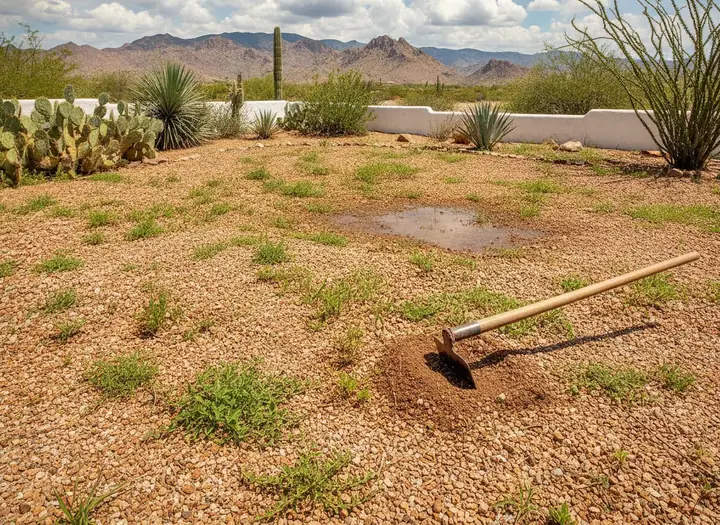
Most Tucson yards are a mix of gravel, desert plants and sometimes a small bermudagrass lawn. In gravel and decomposed granite, a pre-emergent is often the main tool, since there is no turf to protect, and the fall and December applications can make sense there.
Lawns are different if you overseed. University of Arizona guide AZ1817 puts Tucson's winter rye overseeding window at September 25 to October 5. Because pre-emergents block seed, a fall application on that lawn can undo the overseeding. Many homeowners treat the gravel in fall and leave the lawn alone until the spring window. Our guide to winter overseeding in Tucson covers the seeding side.
Weeds a pre-emergent won't solve
Pre-emergents prevent new seedlings; they don't remove weeds that are already growing. Established weeds usually need pulling, hoeing or a post-emergent product. Two Tucson problems deserve a note:
- Buffelgrass. This invasive grass is a fire risk. Pima County says stands can burn at over 1,400 °F, almost three times hotter than fires in native vegetation. Pima County has rules for buffelgrass in unincorporated areas; check pima.gov for the current requirements.
- Goatheads already up. Once puncturevine has set its spiny burs, removal and cleanup matter more than a barrier. Plan for the April treatment next year.
If you are getting the yard ready for summer storms, our monsoon yard prep guide covers the rest of the checklist.
Who can apply pre-emergent in Arizona
Arizona treats weeds as pests. Under A.R.S. §3-3601, "pest management" includes weeds, and the business of pest management includes "advertising for, soliciting" or performing it. A business doing that work needs a license from the Arizona Department of Agriculture's Pest Management Division under A.R.S. §3-3615.
There is a narrow exemption. Under A.R.S. §3-3613, a gardener doing lawn, garden, shrub or tree maintenance may apply herbicides without that license. But the exemption ends when the person:
- uses preemergent herbicides or sterilants;
- advertises weed management services or offers it as a primary service;
- works as part of a crew of two or more applicators; or
- goes over set daily amounts at one address (5 gallons of mixed liquid or 25 pounds of non-liquid product).
In short: for pre-emergent treatments, or any company that advertises weed control, ask for its Arizona Department of Agriculture Pest Management Division license and verify it with the Department. A gardener working under the exemption must give you treatment records showing the address, date, product, amount and applicator's name. Note that "weed and feed" products contain an herbicide, so they count as weed management too. This is general information, not legal advice.
What pre-emergent costs
Published cost guides put a pre-emergent or weed control application at about $60–$150 per visit (national figures, 2026). Those are typical ranges from published cost guides, estimates rather than quotes. Your price depends on the square footage, how much gravel versus lawn you have, and whether the visit also includes pulling existing weeds. Many Tucson homeowners bundle the spring and monsoon applications into a regular desert landscape maintenance plan. See all ranges on our Tucson landscaping prices page.
Questions to ask before you book
- What is your Pest Management Division license number, and may I verify it?
- Which product will you use, and is it labeled for gravel, turf or both?
- Will you skip my lawn in fall if I plan to overseed?
- Does the price include a monsoon follow-up?
- Will I get a written treatment record after each visit?
Compare at least two answers before you choose. You can learn more on our weed control in Tucson guide, or request free quotes from independent local companies. Tucson Lawn Care Pros is a free quote service: the company you choose quotes, contracts and does the work directly with you.